
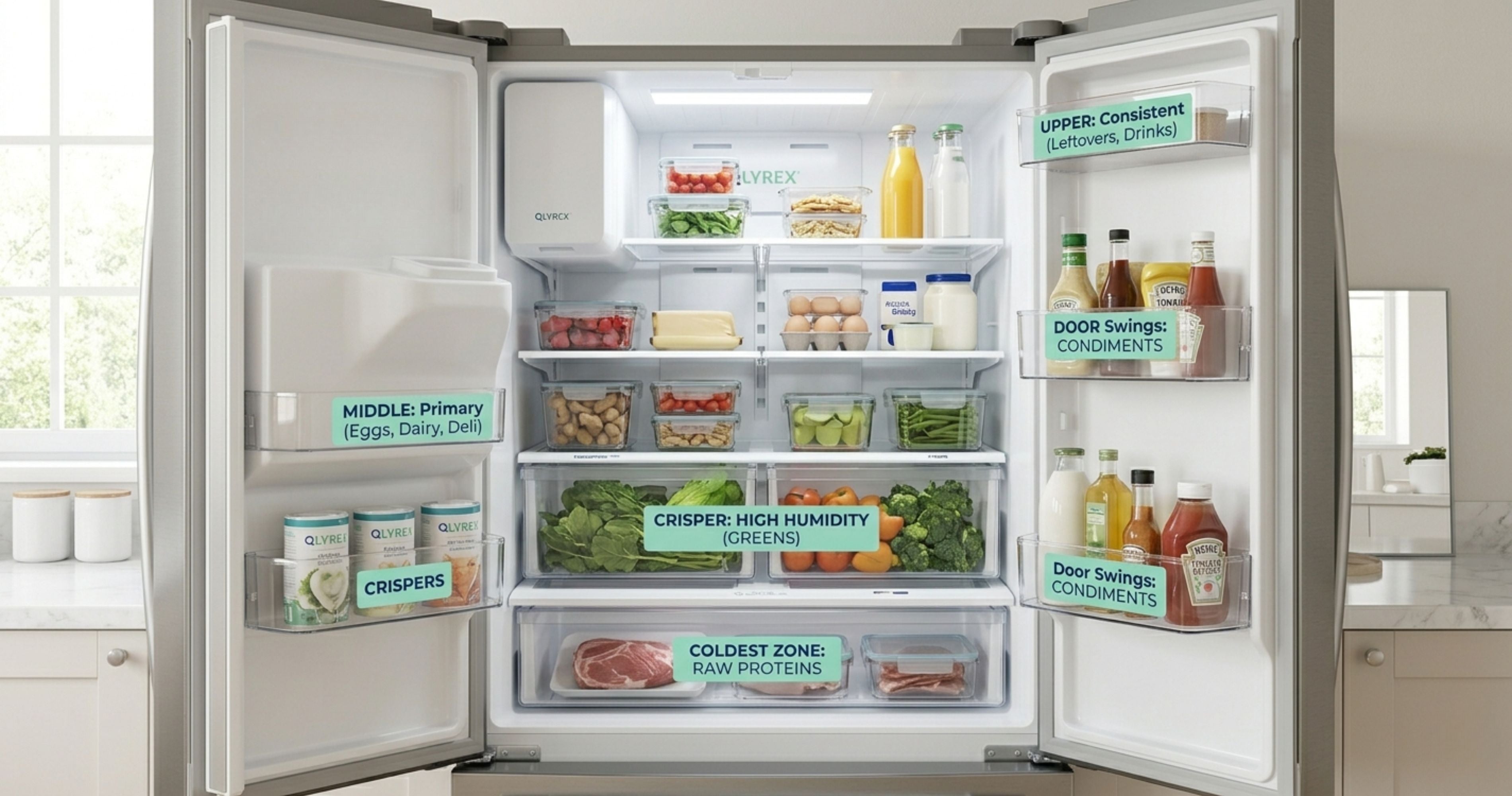
Most people treat their refrigerator like a junk drawer for food—items go wherever there is an open gap. But did you know that your fridge has "micro-climates"? Placing your groceries in the wrong spot doesn't just cause clutter; it actually accelerates food waste and drains your monthly budget.
At Qlyrex©, we apply engineering principles to home organization. Welcome to the science of Fridge Mapping.
The Golden Rule: Temperature Zones
A refrigerator is not uniformly cold. To maximize shelf life, you must match the sensitivity of your food to the temperature of the zone.
1. The Upper Shelves (The "Consistent" Zone)
The temperature here stays the most consistent.
-
What to store: Leftovers, drinks, and ready-to-eat foods (deli meats/hummus).
-
Qlyrex© Pro-Tip: Use our ClearFlow™ Bins here. Since these items are eaten frequently, the crystal-clear visibility ensures you finish your leftovers before they become "science experiments" in the back corner.
2. The Lower Shelves (The "Coldest" Zone)
Cold air sinks, making the bottom shelves the coldest part of the unit.
-
What to store: Raw meat, poultry, and fish.
-
The Safety Factor: Keeping raw proteins on the bottom prevents accidental drips from contaminating the rest of your food. Place them inside a dedicated ClearFlow™ tray to catch any spills and make cleanup a 5-second task.
3. The Door (The "Warmest" Zone)
The door is subject to constant temperature swings every time you open it.
-
What to store: Condiments, juices, and butter.
-
The Common Mistake: Never store milk or eggs in the door. The fluctuating heat will cause them to spoil days faster than if they were kept in the back of the middle shelf.
The Secret Weapon: The "Orbit™ 360" Strategy
The "back of the fridge" is where food goes to die. Jars of pickles, half-used sauces, and specialty dressings often get pushed into the dark, forgotten corners.
-
The Qlyrex© Solution: Place a Qlyrex© Orbit™ 360 Rotary Organizer on your middle shelf. By turning a deep, static shelf into a rotating station, you bring the "hidden" items to the front with one flick of the wrist. This simple move can reduce your condiment waste by up to 60%.
Humidity Control: Crispers & Airflow
Fruits and vegetables have different "breathing" requirements.
-
High Humidity: Leafy greens (wilting-prone).
-
Low Humidity: Fruits and anything that rots easily (apples/pears).
-
The Smart Setup: Use the Qlyrex© Smart Shelf Sensors near your crisper drawers. Our app can alert you if the humidity levels drop too low, reminding you to crisp up your veggies or use them before they lose their nutritional value.
The ROI of an Organized Fridge
The average household throws away nearly $1,500 of food per year. Proper Fridge Mapping isn't just about an aesthetic kitchen; it’s a financial strategy. When you can see what you have, you cook what you have.
Stop losing money to the back of the fridge. [Explore the Qlyrex© Kitchen Collection] and start your mapping project today. Use code FRESH26 for a special discount on all rotary and airtight bin sets.
Share:
The 48-Hour Seasonal Swap: A Stress-Free Guide
The Psychology of a Clean Closet: Why Order Reduces Anxiety